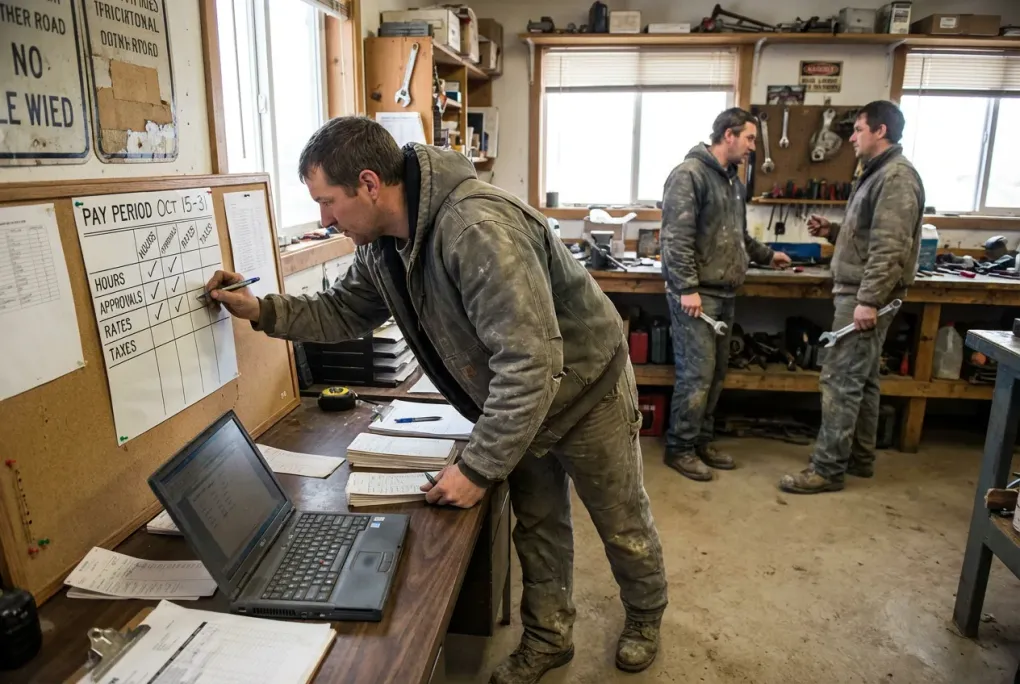
Payroll Checklist for Every Pay Period When You Run Field Crews
If your payroll process feels like chaos every pay period, you are not alone. Maybe your foremen forget to note drive time, hours get scribbled on scraps of paper, or you scramble to track down missing time sheets before payday. This checklist breaks down what you need to do every pay period to keep payroll smooth, accurate, and less stressful.
You will get a clear sequence of steps, practical tradeoffs, and a real-world example from a small roofing crew to show how this works on the ground. No fluff, just what you need to run payroll without headaches.
What to Collect and Confirm Before You Run Payroll
Start by gathering all the raw data. For a crew of 12 roofers, this means:
- Time cards or digital time entries from foremen (including start/end times, breaks, and drive time)
- Records of any overtime or double-time hours
- Job codes or cost centers for each worker’s hours (to track job costing)
- Any bonuses, deductions, or advances to apply this period
Tradeoff: If you rely on paper time sheets, expect delays and errors. Digital time tracking tied to payroll can cut down on chasing missing info and help you see job-level labor costs instantly. But it requires some upfront training and buy-in from your foremen.
Who Is Responsible for What: Divide and Conquer
Assign clear roles:
- Foremen: Collect and verify crew hours daily, including travel and lunch breaks. They should submit time sheets or approve digital entries by the end of the last workday in the pay period.
- Office or Payroll Admin: Review submitted hours for accuracy, check for missing entries, and enter data into the payroll system.
- Owner or Manager: Double-check overtime calculations and final payroll summary before submission.
Scenario: On a roofing crew, foremen often forget to record drive time between sites. By making this a daily checklist item for foremen, you avoid underpaying or having to fix payroll later.
A Simple Payroll Checklist for Construction Crew Owners
Here is a straightforward payroll checklist construction crew owners can run every pay period. You can print this or turn it into a recurring task list.
Step 1: Before the pay period starts
- Set the workweek and pay period dates in writing.
- Confirm overtime rules for your state and any union or project agreements.
- Make sure every active worker is set up correctly in your payroll system.
- Share expectations with foremen on when and how time must be submitted.
Step 2: During the pay period
- Have crews clock in and out daily, with job and task codes.
- Require foremen to review and approve time entries each day.
- Track any bonuses, per diems, or equipment deductions as they happen.
- Flag unusual days early, like 12+ hour shifts or missed punches.
Step 3: End of pay period
- Collect all time sheets or confirm all digital time is submitted.
- Check for missing days or missing workers.
- Review overtime and double time for each worker.
- Confirm job codes are filled in for every hour.
Step 4: Right before you run payroll
- Enter or import time into your payroll system.
- Spot check totals for a few workers against their time sheets.
- Apply bonuses, deductions, and reimbursements.
- Review a draft payroll register and correct any issues.
Step 5: After payroll is processed
- Confirm direct deposits or checks are funded and sent.
- Save payroll reports and time records in a secure folder.
- Note any corrections you had to make so you can fix the root cause next period.
If this still feels like too many moving parts, our guide to the best payroll and time tracking setup for 10 to 50 person construction crews walks through how to simplify this with the right tools and roles.
Check for Common Errors Before Approving Payroll
Before you hit “process,” run through this quick checklist:
- Confirm all crew members have submitted hours.
- Verify overtime rules are applied correctly (for example, after 40 hours per week or double time on holidays).
- Check that job codes match the right projects.
- Make sure any deductions (like equipment rental or advances) are documented and authorized.
- Ensure new hires or terminated employees are updated in the payroll system.
Missing one of these can cause payroll corrections that waste time and frustrate your crew.
How to Handle Job Costing and Payroll Together
Tracking labor cost by job is crucial for small crews to bid better and spot unprofitable projects. Make sure your time tracking method captures job codes or tasks alongside hours.
For example, a landscaping crew of 15 might track hours separately for mowing, planting, and irrigation work. This helps you see which tasks eat up labor and adjust pricing or crew assignments accordingly.
If you are still using spreadsheets, consider switching to a tool that ties time tracking directly to payroll and job costing. That way you avoid double entry and reduce errors.
For a deeper dive on seeing labor cost by job with a small team, take a look at our guide on how to see your labor cost by job when you only have a small crew.
Fixing the Pay Period Workflow: A Roofing Crew Example
A 10-person roofing crew was losing hours on paper time sheets. Foremen collected hours weekly but forgot to include drive time and did not always record overtime correctly. Payroll took two days to process, and paychecks were often delayed or inaccurate.
After switching to daily digital time tracking with job codes and making foremen responsible for daily submission, the crew owner saw these improvements:
- Payroll prep time dropped from 2 days to half a day.
- Overtime was caught and paid correctly every time.
- Drive time was tracked and paid without chasing foremen.
- Job costing reports showed which roof types were most labor-intensive.
This change took some training but paid off quickly in fewer payroll headaches and happier crews.
Certified Payroll Checklist Tips for Construction Crews on Public Jobs
If you are working on public or prevailing wage jobs, certified payroll adds another layer of complexity. Here is a quick checklist to keep certified payroll clean and compliant:
- Collect certified payroll reports from your payroll provider or software that include worker classifications and wage rates.
- Verify that wage rates meet or exceed prevailing wage requirements for each job classification.
- Confirm fringe benefits are accounted for correctly (cash or bona fide benefits).
- Keep daily logs of hours worked per job and classification, signed by foremen or supervisors.
- Submit certified payroll reports on time according to contract or government deadlines.
- Retain all payroll records and certified reports for at least three years.
Missing certified payroll details can lead to contract penalties or payment delays. If you are new to certified payroll, check out our guide to Certified Payroll Basics for Small Contractors for a deeper dive.
Construction Payroll Compliance Checklist: Avoid Costly Mistakes
Compliance is not just about following rules. It is about avoiding fines, delays, and headaches that come from missed details. Here is a quick compliance checklist to run through every pay period:
- Confirm worker classifications are correct (employee vs contractor, apprentice vs journeyman).
- Check that wage rates and overtime calculations meet federal, state, and local laws.
- Verify that all required taxes (federal, state, local) are withheld and reported.
- Make sure certified payroll reports (if applicable) are complete and submitted on time.
- Document and authorize any deductions or advances.
- Keep accurate records of all payroll transactions for at least three years.
- Stay updated on changes in labor laws or prevailing wage rates in your area.
Failing compliance checks can result in penalties or contract holdbacks. If you are running crews in more than one state, our guide on running construction payroll across multiple states can help you avoid surprises.
Do Construction Workers Qualify for Overtime Pay?
Yes, most construction workers do qualify for overtime pay under the Fair Labor Standards Act (FLSA) and state laws. Here is what you need to watch for:
- Overtime usually kicks in after 40 hours worked in a workweek.
- Some states have daily overtime rules (for example, overtime after 8 hours in a day).
- Double time may apply on holidays or for hours beyond a certain threshold.
- Exemptions exist but are rare for field crew workers.
Example: If a crew member works 45 hours in a week, the first 40 are at regular pay, and 5 hours should be paid at 1.5 times the regular rate. Missing this can cause payroll errors and upset your crew.
Make sure your foremen track hours daily and verify overtime before payroll runs. For common pitfalls, check out our article on The Most Common Overtime Mistakes Small Crew-Based Businesses Make.
Why Is Certified Payroll Important for Construction Jobs?
Certified payroll is a must-have when you are working on public or prevailing wage jobs. It is a detailed report that confirms you are paying the correct wages and benefits as required by law.
Here is why it matters:
- It keeps you compliant with government contracts.
- Prevents payment delays or penalties from agencies.
- Provides transparency and proof that workers are paid fairly.
- Helps you avoid costly audits or contract disputes.
If you are new to certified payroll, do not wait until the first report is due. Set up your process early, train your foremen on daily time tracking and classifications, and use software that can generate certified payroll reports easily.
For a step-by-step guide, see Certified Payroll Basics for Small Contractors.
How to Track Hours and Job Costs for Field Crews Without Losing Your Mind
Accurate job costing starts with good time tracking habits. Here is a simple approach to keep it manageable:
- Use job codes or task categories on every time entry (for example, “Site prep,” “Electrical,” “Cleanup”).
- Have foremen verify time and job codes daily, not weekly.
- Use a mobile-friendly time tracking app so crews can clock in and out and select jobs on the spot.
- Review job costing reports weekly to catch errors early.
- Tie your time tracking data directly into payroll to avoid double entry and mistakes.
For crews still on paper, moving to a digital system can save hours each pay period and improve job cost visibility. This helps you spot which jobs or tasks are bleeding labor dollars before it is too late. A simple time tracking tool that ties job codes to payroll and billing, like TimeCamp, can be a good first step without overhauling your whole system.
What Payroll Records You Need to Keep for Construction Crews
Good records protect you during audits, disputes, and certified payroll reviews. At a minimum, keep these construction payroll records:
- Time records: Daily hours for each worker, including start and end times, breaks, and job or task codes.
- Pay records: Pay rates, overtime rates, bonuses, per diems, and deductions for each worker.
- Employee files: W4s, I9s, offer letters, union agreements, and any written pay agreements.
- Job records: Which workers were on which jobs each day, including classifications for prevailing wage work.
- Tax filings: Copies of payroll tax filings and payment confirmations.
- Certified payroll reports: If you work public jobs, keep all certified payroll submissions and backup.
Most laws require you to keep payroll records for at least three years. For public work or union jobs, your contracts may require longer. A simple way to stay organized is to keep a digital folder for each year, with subfolders for payroll runs, time records, and certified payroll.
What Records Do You Need to Keep for Construction Crew Payroll Audits?
If you ever face a payroll audit, the question is not just “Did you pay correctly?” but “Can you prove it?” Here is what you should have ready for at least the last three years, and longer for public or union work:
- Detailed time sheets or digital time logs for every worker, showing:
- Date, start and end times, and total hours
- Breaks and unpaid meal periods
- Job or project codes and, for prevailing wage, worker classification
- Payroll registers and pay stubs for each pay period, including:
- Regular and overtime hours and rates
- Gross pay, deductions, and net pay
- Employer taxes and contributions
- Employee and contractor paperwork:
- W4s, I9s, and any state withholding forms
- Offer letters or written pay agreements
- Subcontractor agreements and W9s for 1099 workers
- Job and certified payroll records for public work:
- Certified payroll reports and any correction filings
- Prevailing wage determinations used for the project
- Daily logs or foreman reports showing who was on which site
- Supporting documents for deductions and bonuses:
- Signed equipment or tool deduction forms
- Bonus plans or written approvals
- Per diem policies and logs
If you build this into your normal payroll checklist, an audit becomes pulling files, not a fire drill.
Payroll Checklist Construction Crew Owners Can Use Every Pay Period
- Collect time data daily or at least by the last workday of the pay period.
- Have foremen verify hours, including drive and break times.
- Check for overtime and apply correct rates.
- Confirm job codes or tasks are assigned to all hours.
- Review deductions and bonuses for accuracy and authorization.
- Update employee status (new hires, terminations, changes).
- Enter or import data into payroll system, double-check totals.
- Approve payroll and schedule payments before the deadline.
- Save reports and backup data for records and audits.
Wrapping Up: What to Do This Week
Pick one pay period coming up and apply this checklist step by step. If you are still relying on paper or end-of-week time collection, try moving to daily submissions or a simple digital time tracking tool that links to payroll. This small change can save hours chasing missing info and reduce payroll errors.
If you want to see how job-level time tracking can simplify payroll and job costing, you can test a basic time tracking and job costing app that connects to payroll and billing, then roll it out to one crew before you expand it.
For more on setting up payroll for your crew size, see our guide to Best Payroll and Time Tracking Setup for 10 to 50 Person Construction Crews.
And if you are juggling W2 employees and contractors, the W2 and 1099 payroll guide can help you avoid compliance headaches.
Get this payroll routine nailed down, and you will spend less time on paperwork and more time running your crews.
Common questions from owners
What is included in a construction payroll checklist?
A solid construction payroll checklist includes verified hours (with drive and break times), correct overtime and double time, job and task codes for every hour, bonuses and deductions with backup, updated employee status, and a final review of totals before you approve payroll. For public work, it also includes certified payroll reports and prevailing wage checks.
What records do I need to keep for construction payroll and possible audits?
Keep daily time records, pay rates and overtime calculations, pay stubs or registers, tax filings, employee paperwork, job assignments, and any certified payroll reports. For audits, you also want signed deduction forms, bonus approvals, and copies of prevailing wage determinations. Store everything for at least three years, and longer if your contracts or state rules require it.
How should I handle overtime pay for construction workers?
Define your workweek in writing, track hours daily, and have foremen review time every day. Pay at least 1.5 times the regular rate after 40 hours per week, or sooner if your state or union rules require daily overtime. Review a draft payroll report each period to catch missed overtime before you run payroll.
Do construction workers always qualify for overtime pay?
Most field crew workers do. A few office or management roles may be exempt, but that is rare on jobsites. If a worker is swinging a hammer, running equipment, or doing hands-on work, plan on paying overtime unless a qualified advisor tells you otherwise.
What are the prevailing wage requirements I should watch for on public jobs?
For prevailing wage work, you must pay at or above the posted wage rate for each classification, track hours by job and classification, handle fringe benefits correctly (cash or approved benefits), and submit accurate certified payroll reports on time. Your bid package or agency website will list the exact rates and rules for each project, and you should keep copies of those with your payroll records.
This payroll checklist and tips should help you tighten your process and avoid common payroll headaches. If you want to improve your certified payroll or job costing further, check out our related guides linked above.